





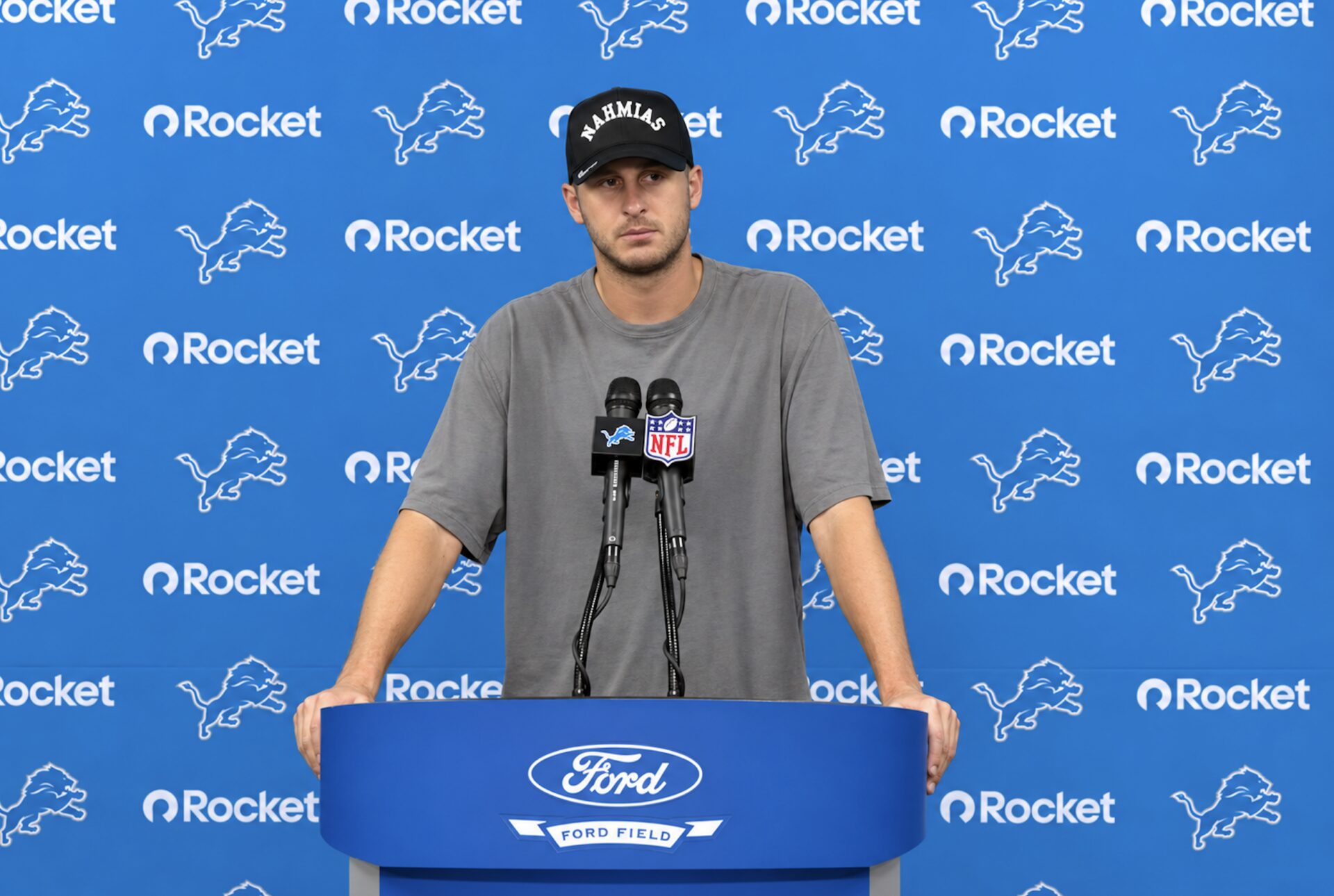


Jared Goff absolutely shredded the Buffalo Bills the last time they faced the Detroit Lions.
He completed 38 of 59 passes for 494 yards, five touchdowns and zero interceptions. Amon-Ra St. Brown caught 14 passes for 193 yards. Sam LaPorta added 111 receiving yards.
Detroit scored 42 points.
And lost.
That 48-42 defeat at Ford Field on Dec. 15, 2024 should serve as a pretty useful reminder heading into Thursday night’s rematch in Buffalo. Goff’s monster stat line looked spectacular, but it was also a product of a game Detroit spent chasing after falling behind 14-0 in the first quarter.
The Lions’ official recap of that 2024 matchup shows Detroit produced 521 total yards and six touchdowns. It still was not enough because Buffalo controlled the game in a completely different way.

Detroit’s Run Game Essentially Disappeared
The numbers tell the story.
Detroit rushed 15 times for 48 yards in the entire game. Buffalo ran 34 times for 197 yards.
Jahmyr Gibbs carried only eight times for 31 yards and a touchdown. David Montgomery managed four yards on five attempts. Goff accounted for the other 13 rushing yards himself.
The official NFL gamebook shows an even more revealing split. Detroit actually ran 11 times for 41 yards in the first half. Gibbs had 27 yards on six attempts, a respectable 4.5 yards per carry.
Then Buffalo stretched its advantage.
Detroit ran the football four times in the entire second half.
At that point, Goff was no longer simply operating Detroit’s offense. He was being asked to rescue the game one possession at a time.
Goff’s 494 Yards Were a Symptom, Not the Formula
That distinction matters.
A quarterback throwing for nearly 500 yards usually looks like evidence of offensive domination. In this case, it was also evidence that Detroit had been forced into a passing game.
Buffalo led 14-0 after one quarter and 21-14 at halftime. The Bills then scored touchdowns on their first two possessions of the second half to build a 35-14 advantage.
Detroit had little choice but to accelerate.
Goff was terrific doing it. He threw touchdown passes to Tim Patrick, Dan Skipper, St. Brown, Gibbs and Jameson Williams. Detroit scored 28 second-half points and got within six with 12 seconds remaining.
But Buffalo never had to respect Detroit’s running game late.
The Bills could rush the passer, defend the boundaries and force Detroit to keep earning possessions through the air.
Goff nearly pulled it off.
Nearly is doing a lot of work there.
Lions Need the Week 1 Formula Against Buffalo
Detroit showed a much healthier offensive formula in Sunday’s 31-30 overtime victory over New Orleans.
The Lions rushed 33 times for 165 yards, averaging five yards per attempt. Gibbs carried a career-high 29 times for 156 yards and two touchdowns. Goff attempted 39 passes, but Detroit never abandoned the run even as the game tightened late.
That commitment helped Detroit control long stretches of the game, particularly while building its 21-0 lead.
As we noted in our Week 1 recap, Gibbs was the engine of the offense. Detroit did not need Goff to throw for 400 yards because the Lions consistently stayed ahead of the chains.
And the possibility of an expanded Gibbs workload has been coming for months. Gibbs said during the offseason he was comfortable handling more carries, something we detailed when discussing his larger role in Detroit’s offense.
Thursday would be a very good time to prove that commitment is real.
Running the Ball Is About More Than Gibbs’ Numbers
Detroit does not need Gibbs to run for 156 yards again.
It does need Buffalo to believe the Lions will continue handing him the football.
That affects everything else.
A legitimate rushing threat can slow Buffalo’s pass rush. It gives Goff better play-action opportunities. It helps Detroit stay out of third-and-long situations. Most importantly, sustained drives keep Josh Allen standing on the sideline instead of attacking a Lions secondary that allowed 410 passing yards against New Orleans.
Allen already showed in Buffalo’s opener that he remains capable of turning a game into a shootout. He threw for 334 yards and two touchdowns in the Bills’ 36-31 victory over Houston while adding two more scores on the ground.
Trying to beat Allen by asking Goff to throw 55 or 60 times again is playing exactly the type of game Buffalo wants.

Detroit Cannot Panic if Buffalo Starts Fast
That might be the most important lesson from 2024.
Buffalo is going to make plays.
Allen may hit a deep ball. Detroit may fall behind early. The Bills could score twice before the Lions settle into the game.
None of those things should automatically send Detroit into a pass-only offense.
The Lions have to remain willing to run Gibbs in the second quarter, third quarter and fourth quarter. They need to force Buffalo’s defensive front to tackle him repeatedly and make the Bills defend all 11 players instead of letting their pass rush attack Goff every snap.
Goff proved two years ago that he can torch Buffalo through the air.
494 yards. Five touchdowns. No interceptions.
It was one of the biggest passing performances of his career.
It also ended with him walking off the field after a loss.
If Detroit wants a different result Thursday night, the goal should not be another 500-yard night from Jared Goff.
The goal should be making sure he never needs one.

Recent Comments